Resources Mentioned
*Disclosure: some of the links in this episode are affiliate links, which means if you decide to purchase through any of them, I will earn a small commission. This helps support the podcast and allows me to continue creating free content. Thank you for your support!
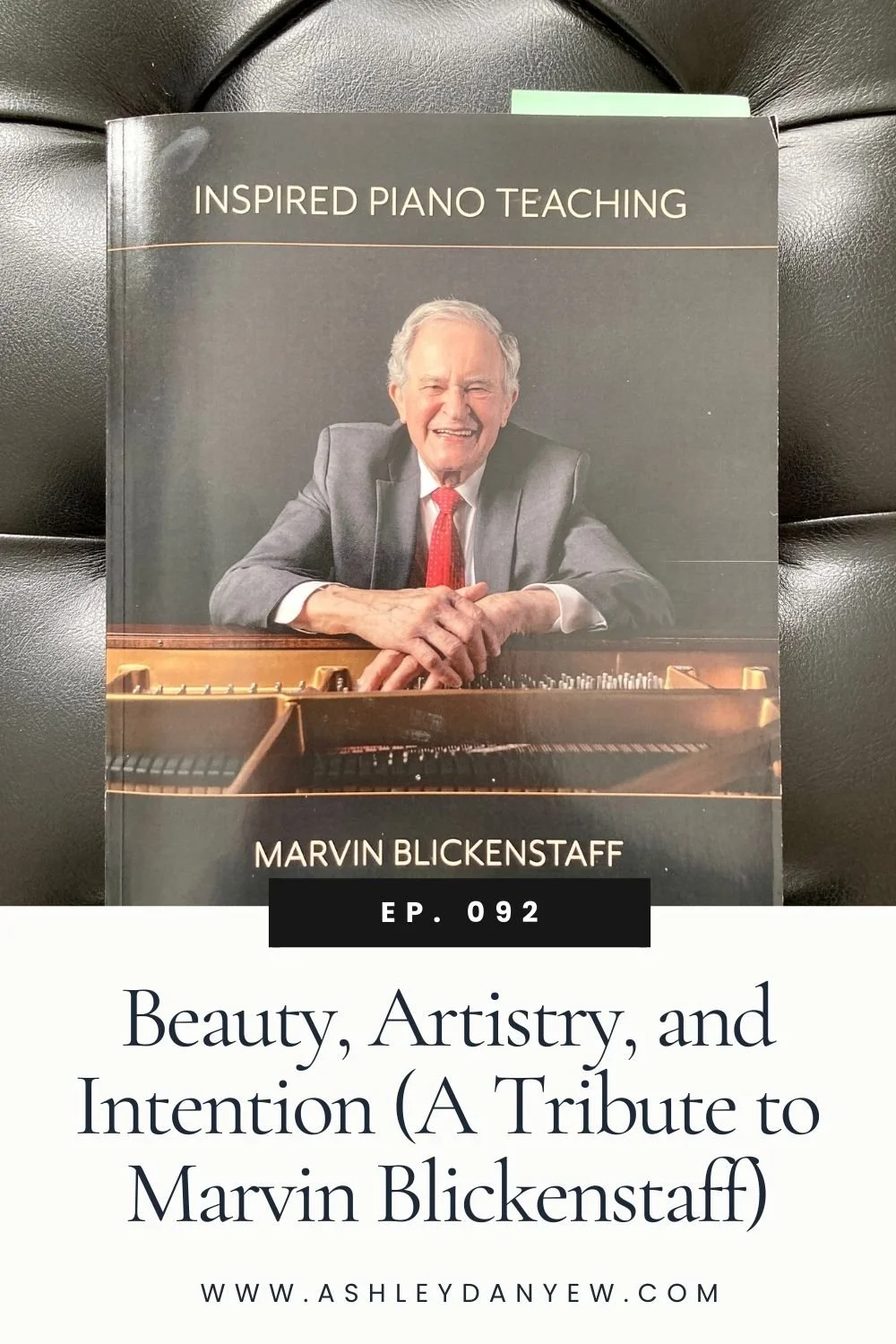
Inspired Piano Teaching (Marvin Blickenstaff)
Ep. 074 - What a First Piano Lesson Looks Like (Here’s My Lesson Plan)
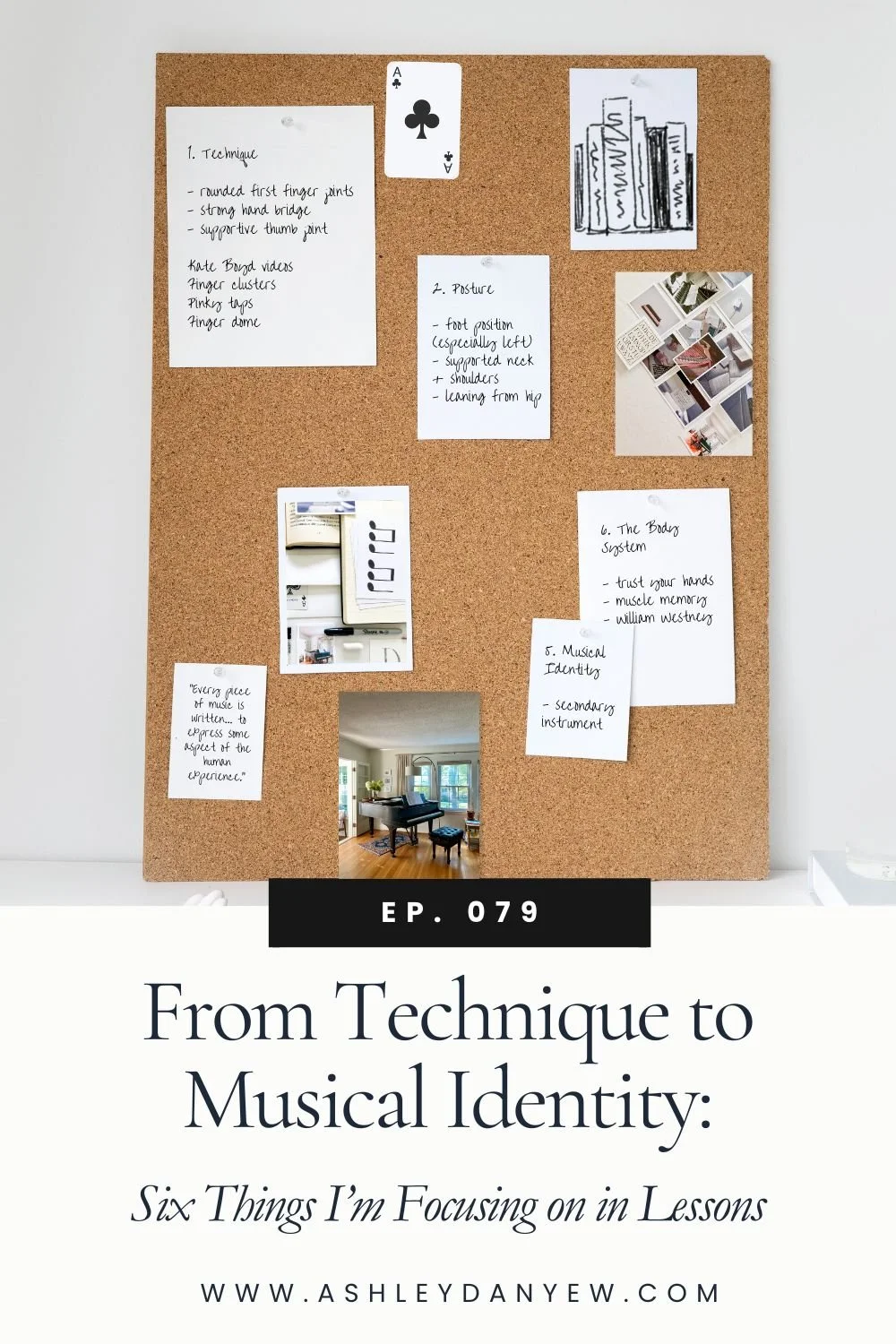
Ep. 079 - From Technique to Musical Identity: Six Things I’m Focusing on in Lessons
Learn Faster, Perform Better (Molly Gebrian)
Ep. 089 - The Science of Practicing: What I’m Learning from Molly Gebrian’s Book
At the end of January, we lost a wonderful musician, teacher, and pedagogue, Marvin Blickenstaff. You’ve probably heard me talk about Marvin on the podcast before—he had a profound impact on my teaching.
With a career spanning over six decades, Marvin dedicated himself to serving piano students and teachers worldwide. He valued deep emotional expression at the keyboard and a human connection through the music. He once said, “The only reason that music exists is to express who we are and how we feel.”
In addition to teaching at the New School for Music Study and maintaining a private home studio, Marvin wrote articles for Piano Magazine and presented numerous webinars and teaching workshops. His book, Inspired Piano Teaching, is dedicated to keeping inspiration and artistry alive for every student in every lesson. Marvin served as Board President and Member for the Frances Clark Center and was awarded Lifetime Achievement Awards from MTNA and the Frances Clark Center. Last year, he performed a 90th Birthday Celebration Recital at Carnegie Hall, which is such an inspiration.
Today, I’m sharing some of the most important things I learned from Marvin and how they show up in my teaching and practice.
The New School for Music Study
I first met Marvin when I was a grad student at Eastman. I was writing my comprehensive exam on the current trends in keyboard pedagogy technique and the influence of Frances Clark. As part of my research, I spent several days at the New School for Music Study in Kingston, NJ, which Frances Clark co-founded with Louise Goss. I met with the faculty, observed lessons and classes, and experienced truly excellent teaching.
At the end of my first day, after observing a lesson with Marvin, I wrote this reflection:
Marvin Blickenstaff, and high school PEPS [Program for Excellence in Piano Study] student, Grace, were already in the midst of Chopin’s Etude in C Minor when I snuck in to observe. Together, they identified the salient motives, determined the differences between the lines of each hand, rehearsed the rhythmic structure, and discussed Chopin’s individualistic thoughts on trills. Similar to the other faculty members, Marvin sought answers from Grace by asking questions and engaging her in conversation about the music. Comments such as, “Talk to me about the fingering in this scale” when working on the first page of the Pathetique Sonata and, “What are four ways you are going to practice this?” assessed Grace’s understanding and encouraged dialogue.
At the end of the second day, I observed a PEPS group class with Marvin. I wrote:
PEPS students meet in small rotation groups every few weeks and in a larger group class of eight students once per month, each an hour in length. Currently, there are 24 students in the program. Marvin began each class with scales, often asking two students to play in ensemble: one ascending and the other descending. The students had end-of-the-year fluency goals posted in the room: 100-160, depending on age and ability. Repertoire included Debussy, Clementi, a Mozart minuet (where Marvin led the students in an impromptu minuet around the room while singing words that fit the melody), a Bach invention, a concerto by Vandall, and lastly, Sibelius’ Romance, to which Marvin stated, “Begin warm, soft, calm, and with a feeling of moonlight. . . Music that is calm is even.” Musical discussions included historical influences, theoretical considerations such as the importance of the cadential 6/4 progression, and phrasing decisions supported by careful pedaling. Students were challenged in thought, touch, and sound.
These few days at the New School had a profound impact on my teaching and were the start of almost two decades of learning from this master teacher.
Marvin’s Influence on My Teaching
Beauty
The first word that comes to mind when I think of Marvin’s teaching is beauty. In 2013, I heard him give a presentation at NCKP, the National Conference on Keyboard Pedagogy, called “Beauty and the Beast in the Piano Studio.” He talked about how often we use the word beautiful in teaching and advocated that it be used sparingly and with discrimination. Students need to hear a beautiful sound and know the standard of what you consider to be beautiful. “Teaching beauty should be our highest priority,” he said, and the word beautiful should be used meaningfully. This stayed with me.
I’ve mentioned Marvin numerous times here on the podcast. Here are a few instances:
Affirmation
In Ep. 041, Focus On the Music, I shared this reminder from Marvin: "The student deserves our input, response, and affirmation.” You probably do the first two automatically. It's a familiar cycle in teaching of making suggestions, giving the student an opportunity to try it, and then providing feedback. But that third element is where Marvin really set an example.
If you ever watched him teach, you know he was a wonderful, thoughtful encourager. But the thing that made his words so meaningful is that his affirmation was always very specific and always tied to the music. He'd say things like, "I am so touched by your use of legato in that phrase" or "My ear really appreciates the sound of your crescendo in that line." Such specific and genuine statements.
Lesson Planning
I’ve talked about the influence Marvin has had on my lesson planning, particularly with beginning students. In Ep. 074, What a First Piano Lesson Looks Like, I shared that I start with an exploration of the instrument—what it’s made of and what kinds of sounds it makes—something I observed Marvin do with a student. I have students sweep their right hand from Middle C upward saying, “upward to the right,” and their left hand from Middle C downward saying, “downward to the left” to reinforce direction. We also do the warm-up, “Knock, knock, knock, anybody home?” “Yes, yes, yes, everybody’s here," which teaches wrist motion. I remember Marvin saying once, “To be successful with a beginning student, you must exaggerate.”
I adopted Marvin’s “study unit” idea for intermediate repertoire planning, including assigning YOYO pieces (that stands for You’re On Your Own). These are pieces below a student’s performance level that they learn on their own, without teacher or parent assistance. Students are encouraged to watch dynamics, check that they’re sure they have accurate rhythm, listen for expression, etc. These pieces give students a great feeling of independence and provide great insight into skills the student actually has.
Another thing I do with my intermediate students is ask for a “scale announcement.”
“I’m going to play (key). It has (x number of sharps/flats). They are (named in order)."
"In (key), my RH my 4th finger plays (note)."
"In (key), my LH my 4th finger plays (note)."
I often think of Marvin’s TERRAC framework when planning individual lessons and studio classes.
T = techinque
E = expression
R = reading
R = rhythm
A = aural
C = creativity
This is a useful way to ensure balanced activities and musical development in every lesson.
Artistry
In Ep. 076, I talked about a renewed commitment to artistry, which Marvin talks about in his book, Inspired Piano Teaching. He wrote:
“Let it be proposed that the goal of our teaching is to produce artists. . . .Students who see, hear, and feel beyond the notes on the page, shaping the sound to a highly expressive end. We do not teach to entertain, and our teaching goes beyond the education of intervals, efficient reading, and command over various scale routines. We teach to give students the experience of artistry, the experience of communicating emotion.”
In Ep. 084, Recital Recap & Year-End Reflection, I talked about the three elements of an artistic performance: dynamics, balance, breath. Marvin wrote:
“What constitutes an artistic performance? We assume a correct reading of the score. For many students, that is a big ask. But accuracy is not artistry. An artist, young or old, examines the score carefully to discover the feeling behind the notes, to find the contrasts between sections, and to identify with the emotion that the composer has invested in the music.”
Emotional Expression
I mentioned him in Ep. 079 when I shared six things I was focusing on in lessons. No. 4 was musical expression and emotional awareness, inspired by this quote in Marvin’s book: “We need to preach a doctrine of emotions to students: that every piece of music is written for the same purpose—to express some aspect of the human experience.”
Engaging Practice
Marvin talked about the importance of deliberate, careful practice, cautioning students, “Your fingers remember everything they play.” Neuroscientists have confirmed this, as Molly Gebrian talks about in her book, Learn Faster, Perform Better. I did a podcast episode on that last year, Ep. 089.
I thought of Marvin in a lesson last week when I sang the exercise, “Rock the hand to play the skips. Fingers play the steps” and “This is the sound of Treble G.” In another lesson, I thought of him while doing the steady beat activity he modeled, “Head, head, shoulders, head” and having a Kindergarten student imitate.
Technical Routines
Every morning, I start my practicing with a version of Marvin’s Technical Routines for Busy Teachers, which he presented on a webinar once:
Rotations in every key: major, minor, diminished
Roll around in every key, turning from major to minor
A Hanon exercise (I think he was partial to No. 11)
4-octave scales in every key
A trill exercise
Broken octaves
I wrote a blog post about this with more details. I also remember him saying once, “Play something by Bach every day!” which I am putting into practice this year.
Conclusion
It’s pretty incredible to reflect on all these things—all these marks of influence from one master teacher and pedagogue. I can confidently say that I wouldn’t be the teacher I am today without Marvin.
Did you know Marvin Blickenstaff or were you familiar with his teaching? I’d love to hear your stories and reflections. Can you trace the influence of a teacher or mentor in your work and practice?